The Art of Nokshi Katha
Craft
"Fifteen thousand hand-stitches. Weeks of meditative work. One artisan's signature. This is how heritage becomes wearable."
Each Heritage Archive piece requires 15,000 individual stitches, applied entirely by hand. The work is slow. The work is meditative. The work cannot be rushed.
Stage One
Pattern Selection
The Noksha
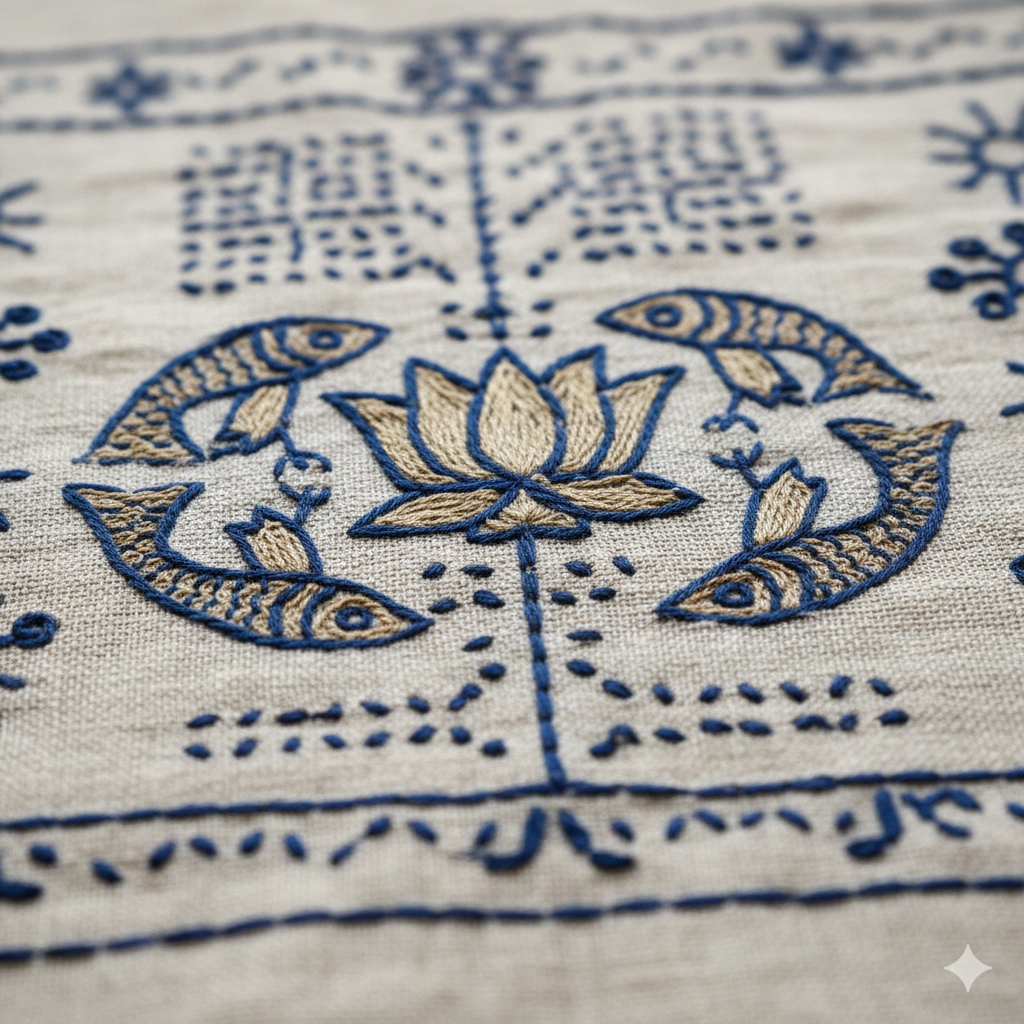
Every Nokshi Katha design begins with the noksha—the pattern. Our master artisans maintain libraries of traditional motifs passed down through generations: the lotus (representing purity), the fish (symbolizing prosperity), the tree of life (connection between earth and sky).
For each piece, the lead artisan selects or adapts a pattern based on the garment's purpose and the season's inspiration. Some patterns are geometric, creating rhythm through repetition. Others are organic, flowing like water or vine.
The pattern is sketched lightly on paper first, then transferred to the fabric using temporary markings that will disappear with the first wash. This is the blueprint. Everything that follows is guided by these faint lines.
Stage Two
Thread Preparation
The Suta
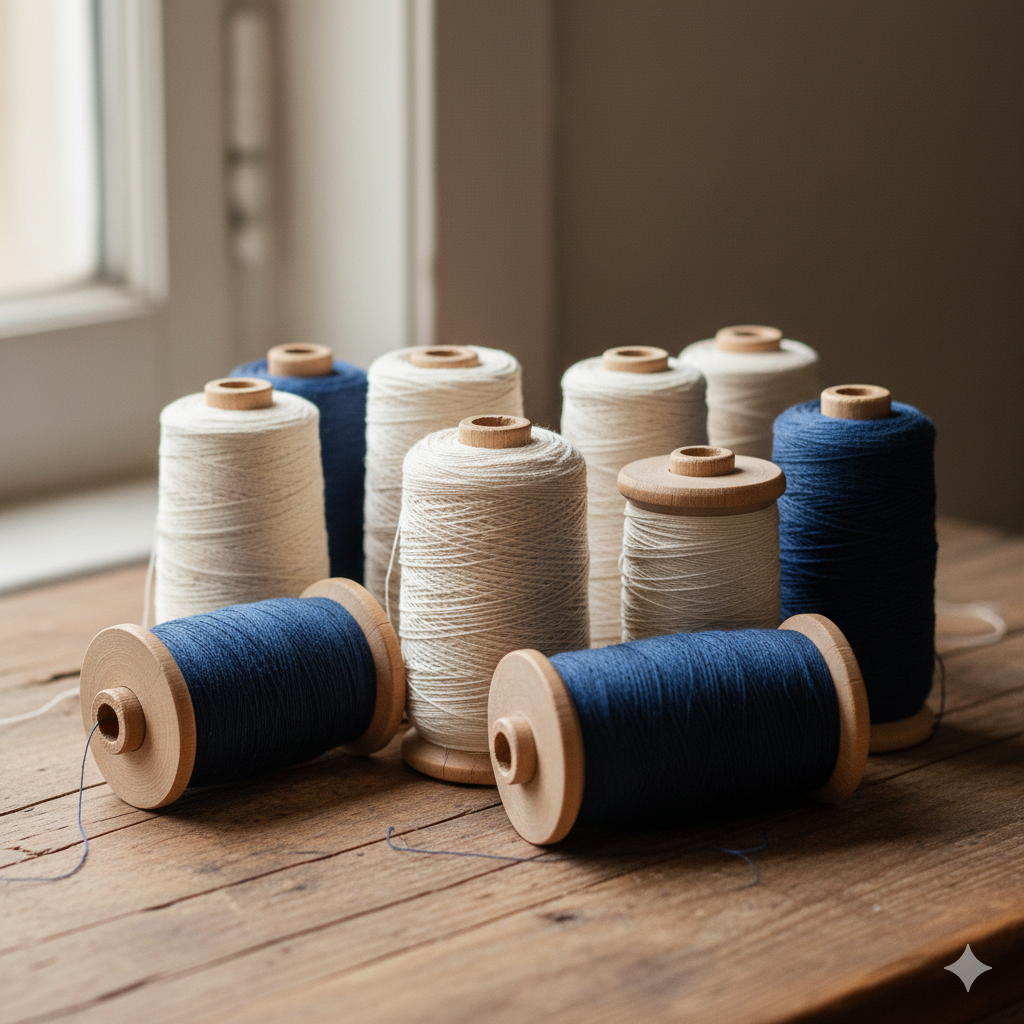
Traditional Nokshi Katha uses cotton thread—sometimes a single strand, sometimes multiple strands twisted together for dimension and depth.
Our artisans prefer natural, undyed thread for most work, allowing the texture itself to create visual interest. For signature pieces in the Heritage Archive, we use indigo-dyed cotton thread that echoes our sapphire palette—a nod to tradition with a contemporary refinement.
The thread is wound onto small bobbins, ensuring smooth flow during stitching. Each artisan prepares several bobbins at the start of a session, knowing she will work for hours without interruption.
Stage Three
Foundation Stitching
First week
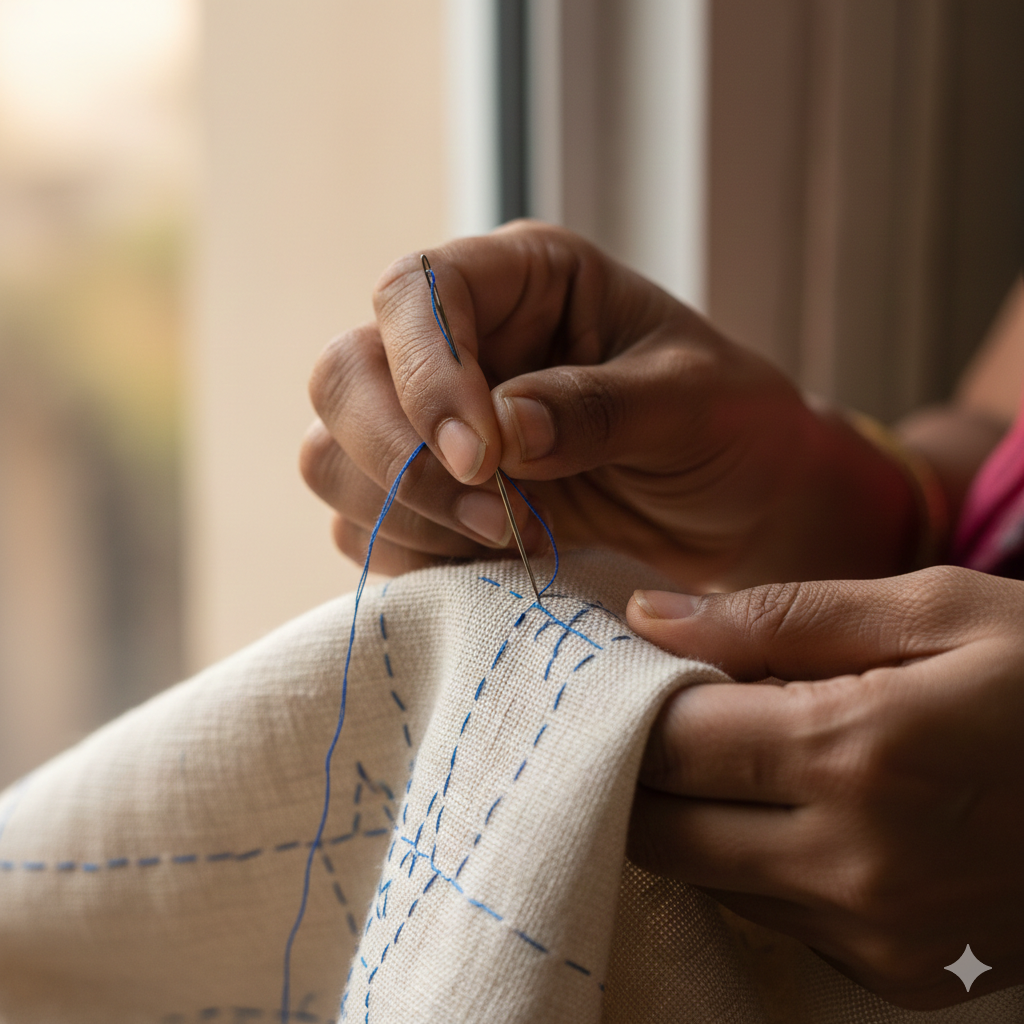
The artisan begins with the outline. Using the traditional kantha running stitch, she follows the transferred pattern, creating the skeleton of the design.
The running stitch is deceptively simple: needle up, needle down, repeated in a steady rhythm. But the spacing, the tension, the angle—these require years of practice. Too loose, and the design loses definition. Too tight, and the fabric puckers.
This first stage establishes the boundaries. It is patient work. The artisan sits with good light, often in the morning hours when her eyes are fresh and her hands are steady.
Stage Four
The Filling
Second & Third Week
Here, the piece reveals itself.
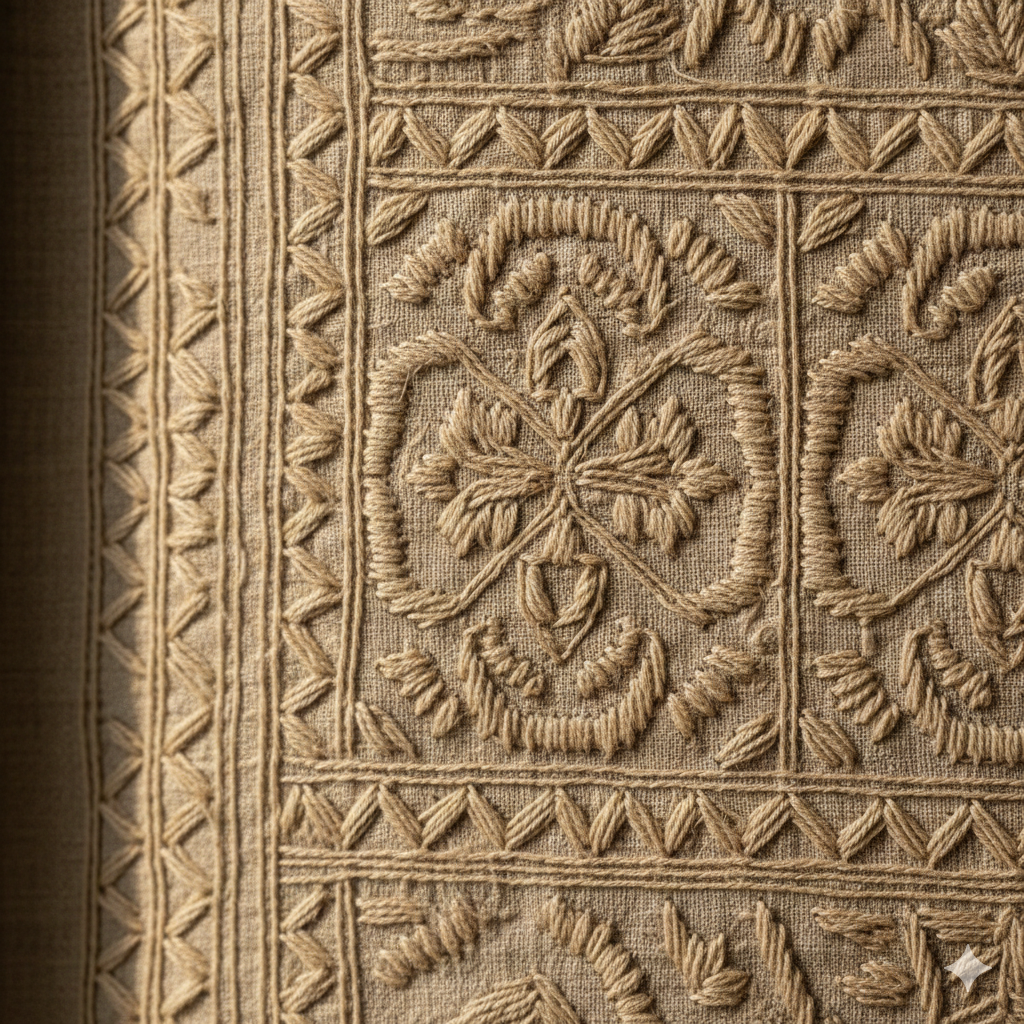
Once the outline is complete, the artisan begins filling the interior spaces with rows upon rows of parallel running stitches. This is where the texture emerges—the dimensional quality that makes Nokshi Katha unmistakable.
The stitches are placed close together, creating a woven appearance. Light catches the ridges. Shadows form in the valleys. The flat fabric becomes sculptural.
This stage requires the most time—often two weeks for a single Heritage Archive panel. The artisan works in sessions of 3-4 hours, pausing when her hands tire or her concentration wanes. There is no rushing this. Mistakes are visible. A single irregular row disrupts the rhythm of the entire design.
Some artisans describe this stage as meditative. The repetition—needle up, needle down, needle up, needle down—becomes a form of moving prayer. Thoughts quiet. Breath steadies. Time disappears.
When the filling is complete, roughly 15,000 stitches have been applied. Each one deliberate. Each one part of the story.
Stage Five
Finishing
Final Days
Once the embroidery is complete, the garment is inspected under natural light. The cooperative's senior artisan examines every section, checking for:
Consistency: Are the stitch lengths uniform?
Tension: Is the fabric lying flat without puckers?
Integrity: Are the thread ends secured properly?
Alignment: Does the pattern flow as intended?
Any irregularities are corrected. Loose threads are trimmed. The embroidered panel is gently pressed (never ironed directly) to settle the stitches.
The artisan signs the cooperative's ledger, recording her work. This record accompanies the garment throughout its journey—from Bangladesh to Canada, and eventually to you.
What Sets This Apart
The difference between machine and hand
A machine can replicate the visual pattern of Nokshi Katha. It can create rows of evenly-spaced stitches in minutes. But it cannot replicate the presence.
When you run your fingers across a Heritage Archive panel, you feel the slight irregularities—the places where the artisan's hand adjusted tension, where one row ends and another begins. These imperfections are not flaws. They are proof.
Proof that a human sat with this fabric for weeks. Proof that someone cared enough to make every stitch deliberate. Proof that this piece exists outside the logic of mass production.
This is why the Heritage Archive pieces take months to produce. This is why we cannot scale beyond what our artisan cooperatives can create. This is why each piece matters.